

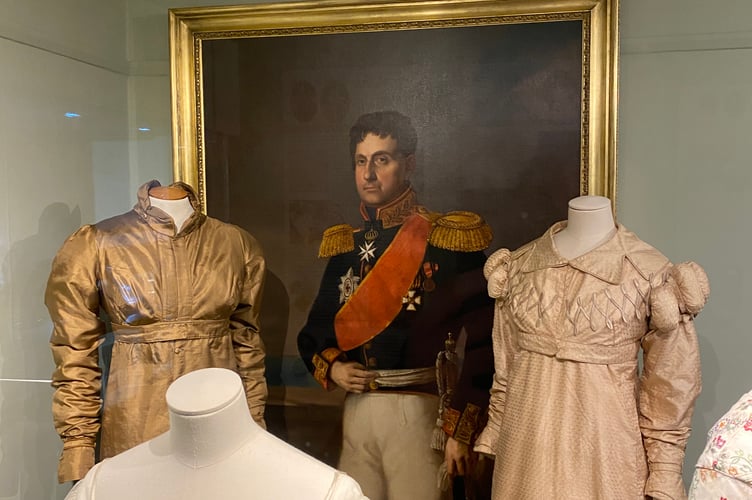
A newly restored painting is one of two exhibitions this season at the Kingsbridge Cookworthy Museum.
The work depicts Thomas Cobley, a figure with both local and international significance.
Cobley was born in the parish of Dodbrooke in 1761. He was the son of the local vicar, Benjamin Cobley, whose name appears as rector of St Thomas à Becket in Dodbrooke. Following the early death of his father, he left home to seek his fortune.
He later moved to Odesa, where he served in the military during the reign of Catherine the Great. By 1792, he had reached the rank of lieutenant colonel and was granted 32,000 acres of land on the left bank of the Odesa estuary in recognition of his service against the Ottoman Empire.


In 1801, he became an Odesa city councillor and, between 1811 and 1812, helped lead efforts to combat a plague which claimed thousands of lives, including many doctors and pharmacists. He later served as head of administration between 1814 and 1815. A street, Coblevskaya, was named in his honour.
The painting is a copy commissioned by Cobley’s great nephew, John von Sonntag Havilland, from artist Romuald Choinaki around 1850, based on an original by Carl Reichel painted in 1819. The original was displayed in the Odesa Art Museum, but its current whereabouts are uncertain following the conflict in the region.
The story behind the painting’s arrival at the museum began in Guernsey. A friend of the museum from Kingsbridge spotted a portrait of a man in military uniform in a private home and recognised its significance. After making enquiries, she discovered it was Cobley.
His family also had wider international links, with one of his sisters marrying a merchant in Livorno, a key trading port at the time.
Cobley’s life unfolded during a period of expansion for the Russian Empire. The region around Odesa was taken from the Ottoman Empire in 1792, with the city founded two years later. The new settlement attracted foreign nationals seeking opportunity, including Cobley.
Historians, including Ukrainian writer Oleg Gubar, have described him as a notable figure in the city’s early development.
Comments
We've recently changed our login process. If you have an account for commenting, you will need to re-register on the login window.
This article has no comments yet. Be the first to leave a comment.