
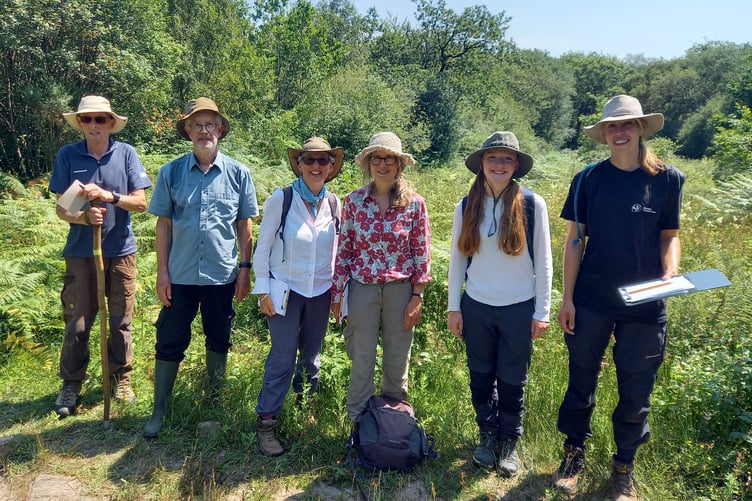
While walking home through the wood last December, after a volunteers’ meeting (second Thursday morning of every month), Fiona van Es and I spotted a clump of Wood Sorrel. We began talking about where else we had seen Wood Sorrel growing in the wood and the distribution of plants in the wood more generally. Fiona said she would try to make a map showing where she had found Wood Sorrel.
Before I reached home the idea had grown. Might it be useful to make maps of where all the plants in our nature reserve grew, from Wood Sorrel to Oak trees? I would devote 2026 to walking round the paths, the clearings and the unexplored corners of Andrew’s Wood and make a map for each species.
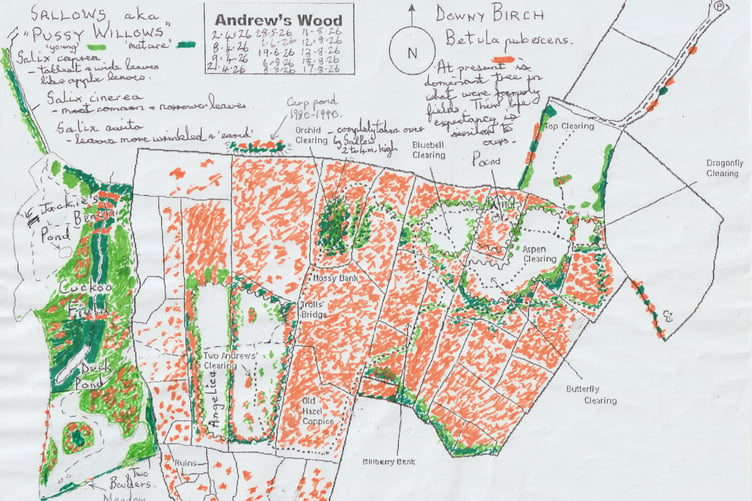
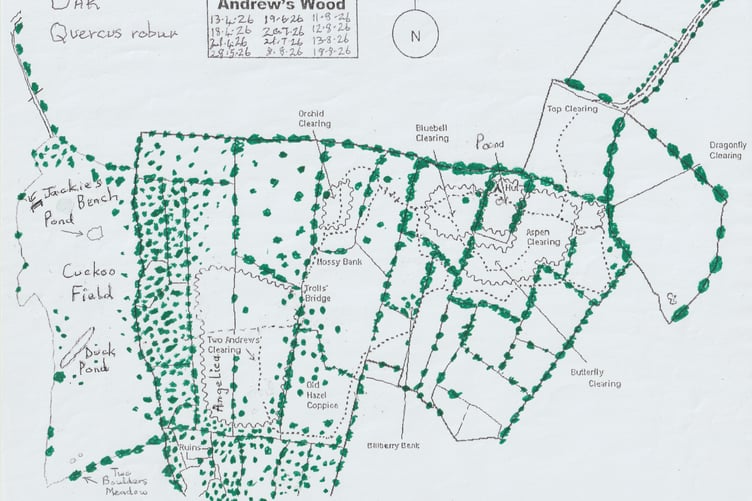
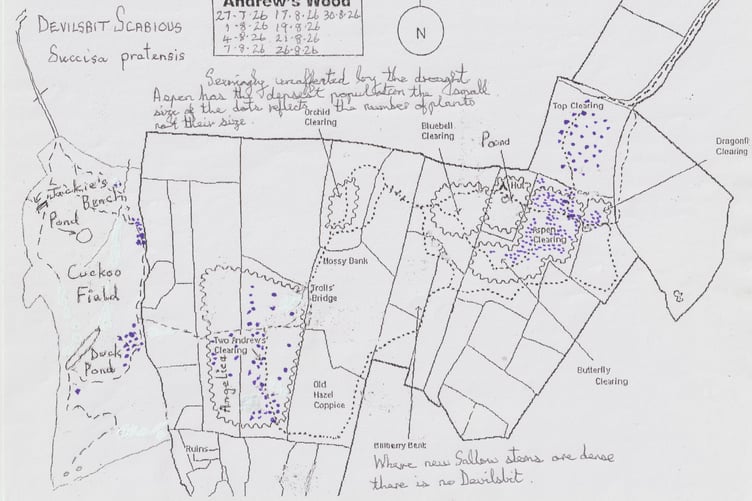
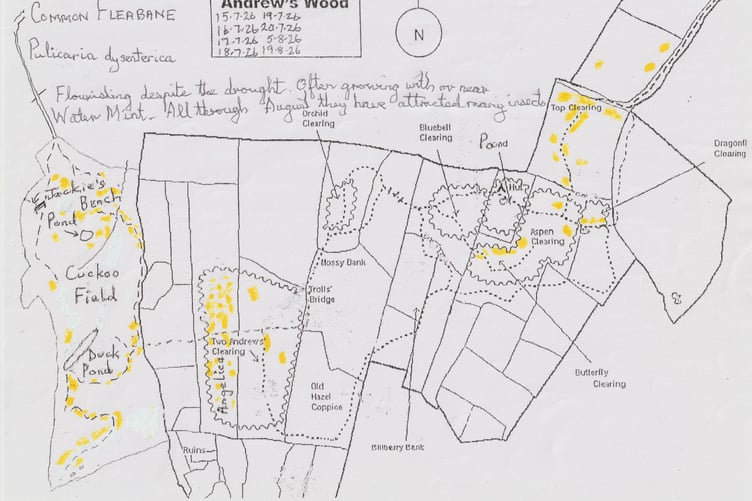
For each visit I made pencilled notes and drawings, showing the distribution of several species. Back at home I carefully made up the species maps with coloured dots or splodges. I recorded the date each time I added some more records. Geoff Foale helped by taking on some of the species.
Now, as November approaches, I have finished and I have made more than 100 visits to the reserve and produced 182 maps, with a commentary and aerial photos to show how the reserve has changed. The last one was for Devilsbit Scabious, whose bright purple buttons of blossom brighten the late summer grasslands. It is the food-plant for the caterpillars of the Marsh Fritillary butterfly. Until 1990 there was a colony of Marsh Fritillaries in Andrew’s Wood; we hope the Devilsbit will still be there if they return.
From these maps we can see where plants were growing in 2026 and can plan which ones need help to survive and which ones need to be controlled to leave space for the rarities like Heath Lobelia. In ten years time other volunteers may repeat the mapping and see whether we and the special plants have succeeded.
Capt. Harris Wise, who lived in nearby Woolston House, first found the Heath Lobelia growing at Stanton Moor, now called Andrew’s Wood, on 15th August 1889, 137 years ago. Lobelia is one of England’s rarest flowers. Its last refuges are fragments of disturbed, heath-grassland. Were it not for the ongoing work of the Devon Wildlife Trust the heath-grassland clearings in Andrew’s Wood would have become woodland. Only six sites for Heath Lobelia remain and in most years Andrew’s Wood has had the largest population.
Heath-grasslands were frequent along the Staddon Ridge, which stretches from Staddon Heights at Plymouth , eastwards to include Andrew’s Wood and finishing above Dartmouth. In the 1950s Ian Mercer came to be the first warden of the Field Studies Council centre at Slapton (soon he would go on to be one of the founders of the Devon Wildlife Trust and later Chief Officer of Dartmoor National Park). He took students regularly to Stanborough, a few miles east of Andrew’s Wood, to study the heath-grassland there. When the land later was sold the fashion was to ‘improve’ rough grasslands by draining them and using fertilizers. The heath-grassland soon disappeared and this has been the story of nearly all of our South Devon heath-grasslands.
Andrew’s Wood’s heath-grassland has not been ‘improved’ but it is threatened by another change, natural succession. First bracken and bramble and then seedling bushes and trees, like Sallow and Birch, rapidly grow over about five years to shade out the heath-grassland species, including Heath Lobelia. The maps show how, since the Second World War, this process has changed Stanton Moor into an Andrew’s Wood of mainly Birch woodland, soon to be overtaken by the longer-lived Oaks.


The Devon Wildlife Trust’s mission is to keep these precious heath-grassland clearings and their wonderful displays of flowers, changing through the year. I have watched in 2026 the Primroses and Bluebells, followed by beautiful spreads of Marsh Orchids, and then in a rush, Greater Birdsfoot Trefoil, Yellow Bartsia, Meadowsweet, Knapweed, giant Marsh Thistles, Hemp Agrimony, Purple Loosestrife, Common Fleabane and Water Mint that so often grow together, Angelica the last of the umbellifers and finally the bright purple buttons of Devilsbit Scabious. I wish it would never end! Claire Inglis and Lineke Bosman our Devon Trust leaders plan to keep our heath-grassland and surprise us with a bumper display of Heath Lobelia soon.
Come and join us, at the reserve car park at 10 am on the second Thursday of every month.
Comments
We've recently changed our login process. If you have an account for commenting, you will need to re-register on the login window.
This article has no comments yet. Be the first to leave a comment.