
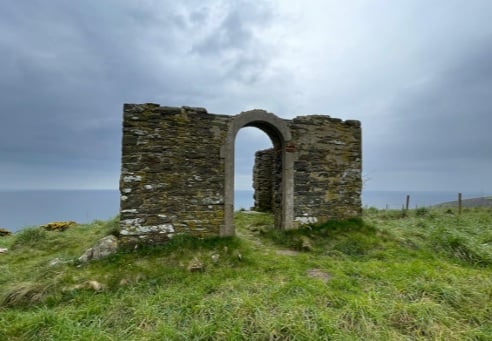
An ambitious plan to transform a ruined ‘pleasure house’ on the South Devon coast path will be scrutinised by planners on Wednesday, October 28.
The proposal from local businessman Geoffrey Sayers of nearby Carswell Farm is to repair and reinstate the historic belvedere at Beacon Hill on the cliffs near Noss Mayo.
It would turn back the clock to a time when it was created by Lord Revelstoke as a tea house for the Membland Estate in the 1880s.
The plan envisages a project in memory of Mr Sayers’ mother, who had a ‘vision’ to see the ruin brought back to life. There are a number of other refurbished properties across the Carswell estate.
The application says: “The reconstructed Revelstoke Tea House would become a landmark building, whose beauty can be enjoyed and its return to the landscape something to be proud of.”
Its design would mirror the ‘slightly quirky’ form of nearby buildings on the estate, and it would be lit inside by paraffin lamps and candles.
The site on the cliffs near Newton Ferrers has been the subject of unsuccessful planning applications before. Plans to turn the ruin into single-bedroom holiday accommodation were refused in 2017.
Since its heyday as a coastal viewpoint for elegant guests of the Membland Estate to take tea and observe nature it has fallen into disrepair. It was once a feature of the nine-mile carriage drive enjoyed by residents and guests of the estate.
It was used as a coastal lookout during the Second World War but since then its roof has fallen in. It is said that the walls were kicked out to allow animals access to the building for shelter.
The current application has the support of almost all of the people commenting on it through the South Hams Council website, and is backed by the local parish council.




However, South Hams officers are recommending that the planning committee should turn down the plans, saying it would harm the character and appearance of the area.
The South Devon national landscape officer says the existing ruins contribute to ‘a sense of undeveloped wild and rugged coastline and tranquillity and isolation’.
Supporters, however, say the project would conserve a local landmark which would otherwise be lost, and would return the building to its former glory.
One says it will provide an ‘uplifting moment of historical and cultural interest’ for coast path walkers.
The ruin is not listed or designated as a heritage asset. The earliest historic evidence of a building on the site dates from 1765 when it was known as a ‘pleasure house’. It was altered in the early 19th century.
A report prepared for the planning committee says: “It is a quite rare and an important example of the romantic 18th century fashion amongst the privileged strata of society to experience nature at its wildest.”
It says the plans should be refused because there is ‘no reasonable justification’ for them and goes on: “It would introduce an incongruous and overly prominent domestic structure into this rugged, undeveloped and isolated cliff top location.”
Comments
We've recently changed our login process. If you have an account for commenting, you will need to re-register on the login window.
This article has no comments yet. Be the first to leave a comment.