
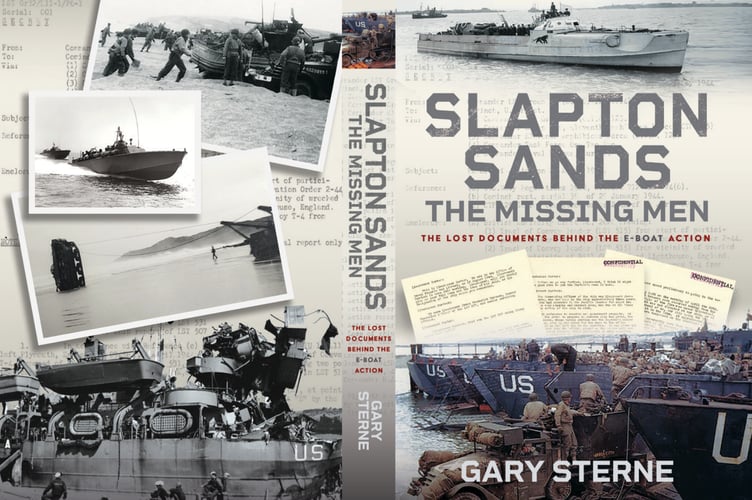
For over eight decades, Exercise Tiger - a vital April 1944 D-Day rehearsal at Slapton Sands - has been shrouded in conspiracy.
Hundreds of American servicemen died when German E-boats attacked Convoy T-4 in Lyme Bay amid the chaos of Allied friendly fire.
In the absence of clear information, locals whispered that victims were hurriedly buried in shallow mass graves across the Devon countryside, alongside rumours of uncounted deaths, overloaded ships, and international coverups.
Rear Admiral Don Moon was historically blamed for the disaster. It was widely claimed his decision to delay the exercise by an hour caused troops to land during a live-fire naval bombardment, resulting in hundreds of deaths.




However, historian Gary Sterne has now debunked this theory and unearthed the truth of the ‘missing men’.
"There were no people killed on the beach," Sterne confirmed. By examining original casualty lists, Sterne has proved in his latest book, Slapton Sands - Missing Men, that the deaths occurred at sea, clearing Admiral Moon.
Sterne also investigated the belief of a "second cover-up" - a theory that American ships sunk their own vessels in the dark. His research revealed that while chaotic friendly fire did occur, killing 15 servicemen, it didn't cause the sinkings.
“It was the German E-boat torpedoes that sent the landing craft to the bottom of the Channel,” he noted.
But if there were no mass graves, why were so many men "missing"?
Sterne found the answer in the US National Archives. He uncovered the original graves registration documents - the initial "we've just found a body" paperwork written before the men were entered into the official cemetery system.
The mystery, Sterne revealed, was the result of an admin transition ‘black hole’.
“When the war ended, many families requested that their sons' remains be repatriated to the US,” Sterne explained.
“When bodies were repatriated, their names were removed from British memorial lists.
“However, because these soldiers had died during a training exercise in England - not in active combat on the continent - they weren’t correctly cross-referenced into the American Battle Monuments Commission (ABMC) databases.”
Human error, including simple spelling mistakes in handwritten manifests, further obscured their identities for decades.
"Nobody before now has ever had these documents," Sterne added. “There are hundreds of thousands of documents across the British and American archives, it was a rabbit hole that lead me to this discovery.
“But I wanted to produce a book based on the actual written word of original documents. For the first time since the Second World War, I could now categorically state what happened to each body.”
For the families of men like Daniel R. Schimanske and Henry Q. Saucier - whose details are now finally available - this research provides the closure 80 years in the making.
There is, however, one exception. A single soldier was found floating in the sea without his military dog tag.
While his name remains unknown, Sterne’s research identifies him as a definitive casualty of the LST sinkings.
The men of Slapton Sands did not die in vain; their sacrifice ensured the success of D-Day.
Now, through one man’s perseverance in wading through reams of primary research, the South Hams can confidently say the men of Slapton Sands were not discarded in shallow graves, their bodies were not deliberately concealed, and they were never forgotten.
Comments
This article has no comments yet. Be the first to leave a comment.