
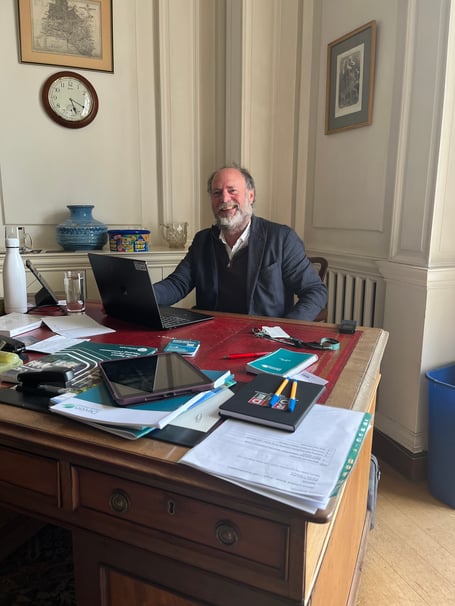
Dealing with the devastation wreaked at Slapton by an unrelenting litany of stormy weather posed one of Julian Brazil’s biggest challenges in his first year as leader.
Not only had a huge chunk of the picturesque A379 Slapton Line washed away in his patch, but he was just over half a year into leading Devon County Council.
That created a dilemma he had hoped he would avoid: having a major incident reported in the specific area he represents, when he also had to balance the whole county’s wants and needs.
“When you are a local member, you can make all the noise you like about mending it, but that was hard for me to do because for every £1 million spent on the Slapton line means it can’t be spent elsewhere,” Cllr Brazil said.



“It brought home the responsibility I had not just as a local member, but as leader responsible for the whole of Devon.”
Having chalked up over 20 years in office at the county council, Cllr Brazil has had some form of involvement in the Slapton line for the best part of a quarter of a century.
“The message was clear in 2018 that if it went again, that would be it,” he said.
That knowledge was a double-edged sword at a community meeting in Stokenham Village Hall just weeks after a huge section of the road was washed away in early February, when Cllr Brazil suggested an alternative future for Torcoss whereby it became a tourism and nature destination without the highway being repaired.
“That was probably a bit insensitive as the situation was emotional for a lot of people,” he recalled.
Cllr Brazil did apologise at the meeting for the comments, but after an emotionally-charged gathering whereby dozens of residents had to crowd outside around windows due to the hall reaching its capacity, he remembers the police – who were present the entire time to manage crowd safety – “suggested I stayed inside for a moment” until people had left at the end.
Sitting in his office in County Hall, he confirms that the council has now sent detailed costings for prospective repairs to central government, and now it’s a case of wait-and-see.
Elsewhere, looking back at his first year in charge since the Liberal Democrats became the biggest single party in May 2025 – albeit without securing an outright majority – Cllr Brazil believes progress in children’s services has been his biggest success.
“The journey had started before our administration took over, but we’ve added extra momentum, and we’re pulling the whole council in the same direction,” he said.
“As a backbencher [in opposition], it was something I felt we weren’t doing as well as we could, so to add momentum to our improvement journey is my biggest achievement, even though we still have a long way to go.”
He believes a key change was putting three cabinet members – including himself – in charge of children’s services, but the department is still technically in Ofsted’s lowest rung.
“We will still get heartbreaking stories from the public who have not been served well, but I hope by the end of our administration that will be down to a trickle,” he said.
“The number of full-time staff has increased massively, and we are increasing our home-grown social workers, which, alongside the levels of absenteeism dropping, means it’s all going in the right direction.”
He states that he felt a “palpable sense of enthusiasm” at a recent meeting of Devon’s social workers, and notes that Ofsted’s monitoring report was “very positive”, with another due in mid-May.
This upbeat analysis has been matched by a government commissioner, Nigel Richardson CBE, who produced a “glowing report” in December.
And a so-called corporate peer challenge – whereby senior members and officials from other councils visit to stress-test how well another authority is performing – has also gone well, he states.
“It would be presumptuous to say that we are doing absolutely everything right, but the legacy issues are being dealt with, and if we can reduce those, that’s positive,” he said.
“One senior officer said they had a good week as they had received two positive messages, whereas before it was a cascade of criticism and desperation.
“In four years’ time, there will still be people who will be unhappy, and we can never be perfect, but I am absolutely confident we are moving in the right direction.”
To secure an administration, the Lib Dems had to strike up a coalition of sorts with the Green Party and the council’s independent members.
A Green councillor, Jacqi Hodgson (Totnes & Dartington), has a cabinet seat, but Reform UK, the biggest opposition party, has often suggested it should have a greater say in decision-making.
“I was in opposition for 20 years, so I understand the frustration,” he states.
But he notes that given 80 per cent of the 60-seat chamber were completely new to being a county councillor, many had a steep learning curve to fully comprehend their role without securing cabinet responsibilities too.
“It brings issues in that they have to learn the ropes, how things work and who to speak to,” he said.
“It’s a learning process for them, and our support staff have done a fantastic job assisting new councillors in finding their feet – I’ve been super impressed across the board.”
Cllr Brazil flags that the council’s recent budget was voted through almost unanimously – with just the two Advance UK members abstaining – as a sign that there is consultation with other parties.
He acknowledges that not all of Reform UK’s national political posturing matches his views, but locally, he states the cohort consists of “hard-working, conscientious, community-minded politicians”.
Cllr Brazil stresses a change of tone and approach characterises his administration, and that outside organisations have noticed “Devon looking out again, and not in”.
But there’s a slight irony that Cllr Brazil could be the last leader of the 137-year-old council due to the process of local government reorganisation, or LGR.
That relates to Westminster’s plans to eradicate the two-tier system of local government, which exists in Devon, and means some services are run by the county council and others by district or city councils, within the same area.
He’s most worried about the impact of Devon being potentially sliced up into three or four unitary councils – which would have responsibility for all services within their boundaries – on key services.
“We’re on our improvement journey with children’s services, but splitting the county council up is the biggest danger,” he said.
“There are children who will not get the best support or help if this council is disaggregated.”
Cllr Brazil believes LGR should not be forced through rapidly, but instead be an evolution, albeit acknowledging quirky echoes of services between county and district councils that make sense to merge.
“I would agree with something like traffic enforcement [being merged] because now we [Devon County Council] monitor on-street parking and districts monitor their car parks – it’s ridiculous to have two traffic wardens in one town with different responsibilities,” he said.
But, there are potentially concerns about how smaller unitary councils would manage the likes of highways, not only filling potholes, but lobbying government for support with major projects – such as rebuilding the Slapton Line.
With Torcross weather watchers, including the area’s MP, Caroline Voaden (Liberal Democrat, South Devon), once again on high alert over strong winds and high tides in recent days, Cllr Brazil will be hoping there’s no more damage at the iconic location.
“I sleep well, but when there’s a big storm, you’re hoping you don’t get a call about the Slapton Line,” Cllr Brazil said.
Comments
This article has no comments yet. Be the first to leave a comment.