
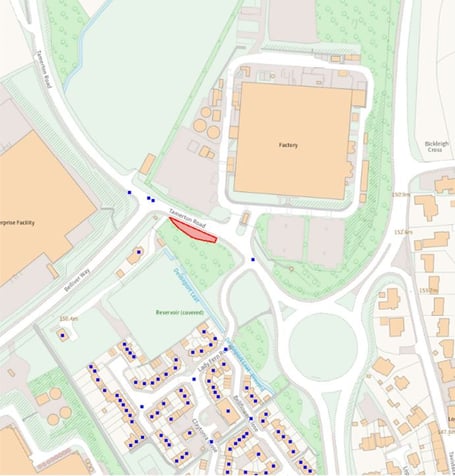
Plymouth’s first battery energy storage system (BESS), on the edge of Dartmoor National Park, has been approved after fire experts were satisfied by its safety measures.
The plan for the roadside battery box system for Tamerton Road at Woolwell was deferred by Plymouth City Council’s planning committee last month for more information to come forward.
Devon and Cornwall Fire and Rescue Service has since reviewed the management system and says that “overall the proposed plan appears to incorporate a sensible standard of fire safety features”.
Members were concerned about thermal runaway which frequently occurs in lithium-ion batteries when internal faults or damage trigger a fast destructive chain reaction, causing heat to generate more heat.
They referred to fires which had occurred at other sites and highlighted the danger of toxic fumes.
They said the unit would be unmanned and at risk from vandals. It was close to hundreds of residents, a main trunk road – the A366 – the national park, wildlife and sports facilities.
The batteries would be contained within four storage cabinets and store clean energy such as solar and wind and feed it back into the national grid at times of high demand.
AMP Clean Energy, which is behind the scheme in Plymouth, says it is developing more than 1,250 battery boxes in the UK over the next three years.
Planning committee members heard at their meeting on Thursday that safety features included smoke and gas leakage detection, automatic shut off and suppression in the event of smoke or gas detected and direct communication links from the enclosure to the operator in the event of a fault or emergency.
Cllr Jeremy Goslin (Lab, Peverell) said he was reassured that the fire service, as the professionals, had taken “ full consideration of the dangers” and there was “a concrete and sensible” set of conditions attached to the planning application.




Pleas were made for CCTV to monitor the site from opponents but the planning officer said this was not deemed necessary.
Officers said recent government policy dictated that substantial weight should be given to low carbon development infrastructure projects that contributed towards net zero.
Eight members voted in favour, with one against and one abstention.
Comments
This article has no comments yet. Be the first to leave a comment.