
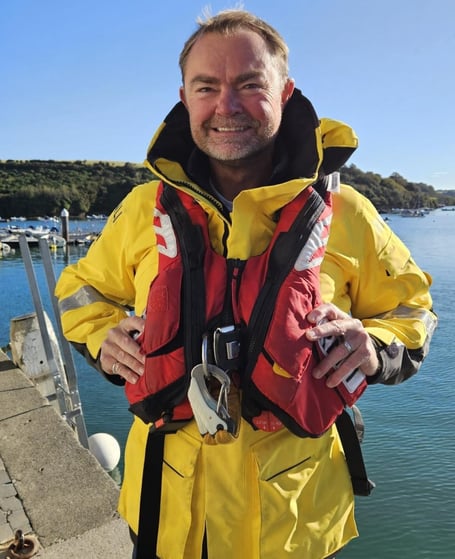
A Salcombe RNLI volunteer has described how joining the lifeboat crew has changed his life, as he urged others to get involved in the lifesaving service.
Steve Walter, 55, joined the RNLI nearly three years ago after retiring from his previous career.
He is a crew member on the station's all-weather lifeboat, Baltic Exchange III, and a qualified navigator.
He is also preparing for the arrival of the new Shannon-class lifeboat, Baltic Exchange IV.
Steve said his experience of sailing and his former work as a scuba diving instructor helped draw him towards volunteering, alongside a desire to work with others and make a difference.
"The RNLI is an incredibly well-known and loved organisation and, with my experience, I thought that I had the right skills that I could probably offer an organisation such as the RNLI." He added: "Working with a team, working with a group of people, a diverse group of people, all from different backgrounds, but all having a collective goal, attracted me to it.”
"And it's, yeah, it's been a great thing to be part of."
Despite his previous experience on the water, Steve said becoming a lifeboat crew member had taught him that there was always more to learn.
He said going to sea during an emergency, particularly during his first few call-outs, was very different from ordinary boating. "You may have experience being on boats, you may have experience being at sea on various different boats, but being at sea on a lifeboat, certainly during a shout, when you're new to it, your first few shouts, it can be quite something else really," he said.
"You soon get used to it, you soon get more at ease with it and people are there to help you along."
-Cleared-for-use-by-LDR.jpeg?width=209&height=140&crop=209:145,smart&quality=75)
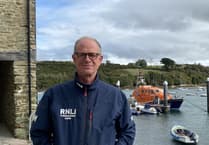
Steve said the RNLI's comprehensive training programme ensured that crew members continued learning throughout their time at the station.
"Nobody will step onto a lifeboat and think that just because they've been a sailor or associated with the sea for years and years that they know it all, because they absolutely don't," he said. "And the RNLI and the situations that we go out in will always throw something new at you that you'll learn from."
The crew trains at sea around twice a week, with shore-based sessions taking place when weather conditions make certain exercises inappropriate.
Steve explained that volunteers must first pass a sea survival course at Poole before they can go to sea as operational crew.
Training begins with basic deck work, rope handling, safety procedures and understanding the capabilities of the boat.
Crew members can then progress to more advanced training, including navigation.
Further opportunities are available for those who want to become qualified navigators, mechanics or coxswains.
Steve has progressed to the navigator programme, although he said volunteers could choose how far they wished to advance.
He said: "The great thing about the RNLI is that you can put your hand up in the air and ask to be taught."
Training also includes maintaining specific skills for particular operations, such as working alongside a Coastguard helicopter.
Steve said: "We train here about twice a week at sea. If the weather's really, really bad, then we will do a shore-based session."
He explained that the crew would not go out simply to train in dangerous conditions if the exercise itself posed unnecessary risks.
"We do occasionally seek out rough weather training, but we won't just put the boat out to sea if it's absolutely foul because it might not be appropriate to be doing certain types of deck work and putting the crew at undue risk," he said.
Steve also explained how the RNLI works alongside HM Coastguard when responding to incidents.
Although the Coastguard requests assistance, the decision to launch rests with the lifeboat station's launching authority, with the coxswain making the final decision on whether the boat and crew should go to sea.
Once launched, the crew works closely with the Coastguard, which coordinates the wider response and can provide information to help direct searches for missing people.
Steve said the Coastguard had access to advanced systems to help establish search locations, while lifeboat crew members used their knowledge of local conditions, including tides and wind, to assess where someone might have been carried.
He said: "We're all trained to devise our own search patterns. We estimate where we think something or somebody might be, given the tide and the wind conditions."
The Coastguard's information helps narrow down the search area, while the lifeboat crew provides observations from the scene.
"They are sitting in an office in Falmouth, they're not at sea. They're trying to build a picture in their head as to what's going on at sea," Steve said. "We'll get on scene, we'll report what the sea conditions might be like, we'll report how much visibility that we've got, because they don't have that information immediately to hand where they're sitting."
When a pager sounds, crew members make their way to the station and gather while the coxswain receives details of the incident.
Steve said the alert still brought a heightened sense of anticipation, regardless of how many times a volunteer had responded.
"It doesn't matter how many times," he said. "I'm sure I can probably talk for the people who have been on the crew for 30-odd years. And we do have people who have been that long-serving. "Your senses sharpen. Something's about to happen."
Salcombe has around 30 seagoing crew members, but their availability varies according to work, holidays and other commitments.
The coxswain selects the crew according to the nature of the call-out, the experience required and who is available.
Steve said this meant balancing the need for experienced crew members during difficult rescues with opportunities for newer volunteers to gain experience.
"If it's a nice, relatively simple job, which could be a tow in relatively benign conditions, it's a great first or second shout," he said. "If it's blowing a force nine, middle of the winter, 20 miles out, then perhaps it might be more appropriate to take the more experienced crew."
Once the crew has been selected, members change into their kit while the mechanic prepares the lifeboat and shore crew assist with the launch.
During the journey, the crew begins assessing the situation, considering potential hazards, casualty care and any injuries that may need attention.
Steve said the team would assess a vessel in difficulty before deciding how best to help.
"When we get to the casualty, we'll do a couple of laps of the casualty vessel, get eyes on, let's really have a look at what's going on, communicate with them, make sure they're all okay, and then we'll formulate a plan to get them into safety," he said.
He added that protecting the crew and lifeboat was central to every operation. "It's just really, really important that the crew are kept safe, the boat's kept safe, and we work on that basis really," he said.
The waters around South Devon present particular challenges at certain times of year.
Steve said Bigbury could be especially busy during the summer, when surfers, kite surfers and kayakers take advantage of apparently calm conditions.
With an easterly breeze, wind can blow over the cliffs at Bolt Tail, leaving the water looking flat and inviting.
However, conditions can change, leaving people struggling to make their way back to shore.
He said: "They quite like it because in an easterly the wind tends to blow over the top of the cliffs of Bolt Tail, so it looks actually beautifully flat and calm.
"And then they'll be out and then the wind will get hold of them, and we quite often get called for stuff going on around there."
The area is supported by other rescue resources, including an independent lifeboat at Hope Cove and beach lifeguards at Bigbury and Bantham.
Further south, the waters around Start Point and the Salcombe Bar can become treacherous when strong winds meet large tides.
Steve said conditions could be particularly dangerous when a strong outgoing tide met an onshore gale. He added that the area remained significant to the crew because of the historic Salcombe lifeboat disaster.
"We never forget that or them," he said. Steve said modern lifeboats offered far greater protection than those available more than a century ago.
"We're fortunate in so much as when we're in that boat, we're probably in the safest place we can be, with the door shut and we're all strapped in," he said. "It's very different to what it was 110 years ago."
Asked what advice he would give to anyone considering joining the RNLI, Steve said he would encourage them to take the opportunity.
He said volunteers did not need to arrive knowing everything about boats or the sea, provided they were prepared to listen, learn and work as part of a team.
"It's certainly changed my life in a really positive way," he said.
"My advice would be do it, definitely."
He added: "If you're willing to listen to advice, if you're willing to be part of a team, you're willing to be taught, and if you like being amongst great people and doing some real genuine good, then I would say absolutely go for it."
Comments
We've recently changed our login process. If you have an account for commenting, you will need to re-register on the login window.
This article has no comments yet. Be the first to leave a comment.