
Our local estuary mudflats are maybe an acquired taste but with knowing a bit more about their often out-of-sight wildlife communities and the wider ecology that they support, I love them. They are a common and almost defining feature of all our estuaries. Whilst many prefer estuary views with the tide in, I’m firmly a tide out person and I like to explore our local estuaries at low tide when I can see more of the whole story, just as most are coming off the water. If you know where to look and are careful not to disturb things, it’s a chance to look at the health of any local dwarf seagrass meadows, the tell-tale scapings of grey mullet fish left as they feed on the diatoms in the surface of mud, some of the exotic looking tentacles of worms that are otherwise hidden in tubes within the mud and even tiny mud caves made by shore crabs along the steep creek channel edges.
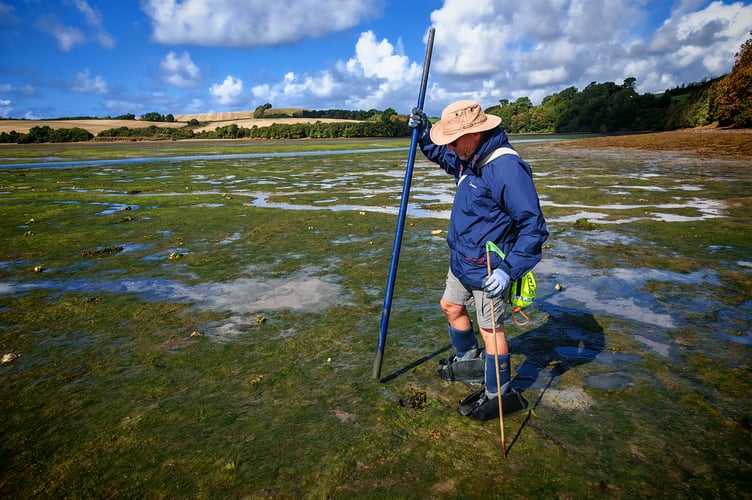
All of our local estuaries have quite significant mudflats, a result of the settling sediments that wash down from their rainwater catchments and to a varied extent their coastal waters. They can feel almost endless (and to the mostly tiny seaweeds and animals that live there, they effectively are!) and they often do extend down under the deeper water channels and are the underlying habitats of lower saltmarshes, dwarf seagrass meadows and once, historically, native oyster reefs again in the deeper more sub-tidal waters. I have some concerns that some of these habitats and their wildlife may be under threat.
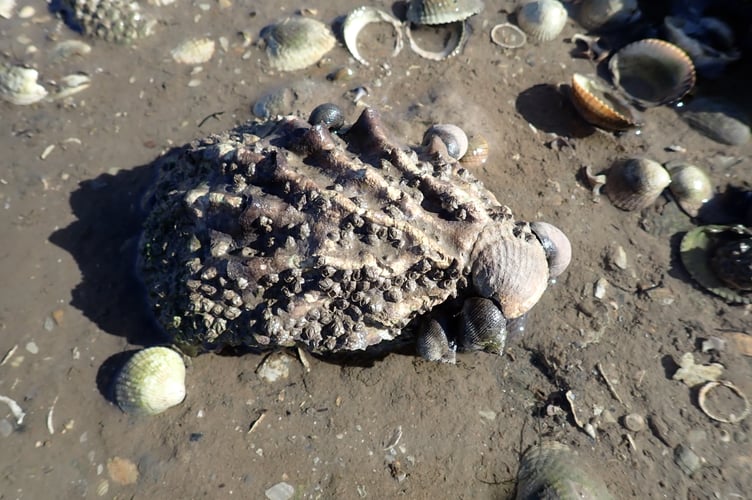
Through the potential invasion of some non-native species, we may be seeing some new wildlife communities spreading over the mudflats and displacing some of their natural native wildlife. Many of us have already seen the growth of Pacific oysters, also known as ‘rock oysters’, over our more sheltered rocky shores but now we are unexpectedly starting to notice them over some mudflats, settling onto native clams, finding the conditions favourable and attracting more of their own. Through my work, I & affiliated organisations have been engaged in a successful trial to manage these oysters and will now upscale this to try to keep on top of them.


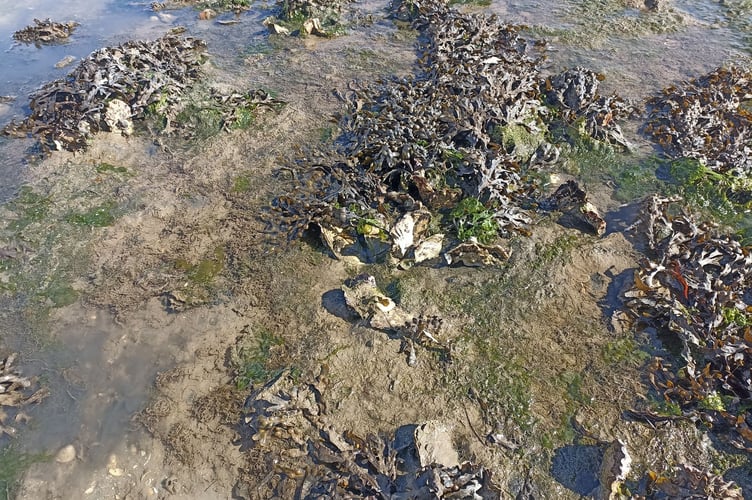
What has really worried us, however, is the discovery of a few isolated areas where these oysters have started to attract others in such numbers that they are forming clumps that then become attachment habitats for native perennial brown seaweeds. Whilst there could be some ecological gains, such as the water filtering by the oysters and the seaweeds forming a tidal seaweed forest habitat when the tide is in, our big main concern is that the rich living habitat that should be here and one that we are actively trying to conserve, the dwarf seagrass meadows are being displaced. While we still have a chance, we are currently exploring how we might physically remove these clumps of oysters, before they join to become living oyster ‘bioreefs’ which would be much more difficult to remove – this will be costly, dirty and difficult work at best.
We would very much like to encourage the restoration of native oyster beds, these would be deeper down into the channels as suggested but the problem here is another non-native species the slipper limpet. We are seeing small numbers of these European oysters on our shores, so we hope they are faring better deeper down, but the slipper limpets will limit them through competition for space and food. We presently have no clever ideas on how we could manage these slipper limpets but they have been around since the turn of the 19th century and maybe aren’t getting any worse (they do thrive in the deeper waters of our estuaries so are rarely seen en masse).
I have reported the new arrival of a seaweed called the ‘worm wart weed’ before, now established in the Tacket Wood Creek, off from the Kingsbridge Creek and within the Mudbank Creek of the Yealm Estuary.
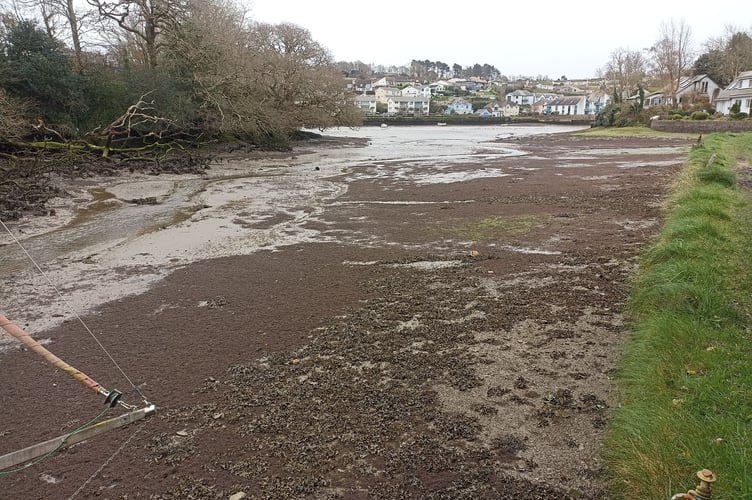
Unfortunately, there is some evidence to suggest that it is spreading around the Kingsbridge Estuary with it turning up within biological surveys that I have been involved with. As with most invasive and non-native species, we have to paint their worst-case scenarios of their environmental impacts as the factors that affect them are so numerous and varied that we cannot predict them. In this instance, I and affiliated organisations are supporting research to try to consider the wider costs and possible benefits of this weed.
As ever with invasive and non-native species, and particularly so with marine and estuarine species, our collective community role is essentially about the preventions that we can and must take to limit their spread either into or out of similar areas because once established, they can be nigh impossible to manage. Please, whatever activity you might be involved in, take time to ‘Check, Clean & Dry’ all of your equipment (footwear, paddles & vessels, buckets & spades, etc.) when travelling or visiting between water bodies.
Check – for animals & plants you can see Clean – for those you can’t
Dry to be sure!
Comments
We've recently changed our login process. If you have an account for commenting, you will need to re-register on the login window.
This article has no comments yet. Be the first to leave a comment.