
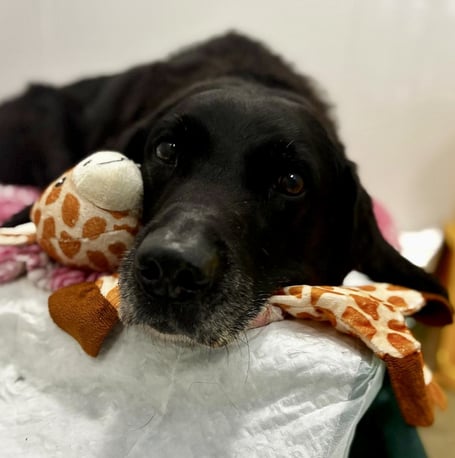
It was a beautiful sunny day in March when Riley the Labrador enjoyed a wonderful trip to the beach, splashing in the water and playing in the sand. He happily went home, warmed up, and tucked into a well-deserved meal before settling down for the night.
As the days passed, Riley began to feel increasingly unwell. First, he went off his dinner, then his breakfast. Then the vomiting started.
He was promptly brought to our Kingsbridge branch on a Saturday, where he was given a thorough examination. Blood tests were run and X-rays were taken.
Riley’s intestines appeared filled with gas—a concerning sign that raised suspicion of a possible blockage. As Riley is an older gentleman, we wanted to be as minimally invasive as possible. He was therefore referred to our Ivybridge branch for a CT scan to determine exactly what was going on.



His abdomen was imaged, and the complex series of scans were sent to a specialist radiologist to ensure we had a complete understanding of the situation.
Because interpreting a CT scan with over 8,000 individual images takes time, we decided to wake Riley up —especially as he was fairly bright, albeit a little nauseous prior to his anaesthetic.
Riley recovered well, but soon began passing a very large volume of diarrhoea containing a significant amount of partially chewed seaweed stalks. These were firm and highly fibrous, having passed through his system with very little change in structure: a very likely cause of the suspected blockage which was subsequently confirmed on the CT.
Once the stalks had passed, Riley became much more comfortable. He stayed with us overnight for supportive care, including pain relief and intravenous fluids. By the following morning, he was back to his usual self.
Riley was discharged the next day. After discussing the findings with his family, we discovered he has quite a fondness for seaweed. To help him continue enjoying trips to the beach without risk of a repeat episode, we recommended a practical solution: a basket muzzle. Riley now visits his favourite spots sporting a colour-coordinated Baskerville muzzle to match his shiny black coat. This allows him to enjoy all the wonderful smells without the risk of eating something that could cause serious problems.
Riley was incredibly lucky that his blockage resolved without the need for surgery. Most patients presenting with intestinal blockages do require surgical removal of the obstruction.
However, seaweed isn’t all bad —we eat it too after all, albeit we choose species known to be safe! In fact, seaweed is a key ingredient in some dental health supplements for pets, particularly a species called Ascophyllum nodosum. When consumed, it works systemically (through the bloodstream) and is secreted in saliva, helping to soften plaque build-up. While it’s not a substitute for brushing (nothing beats brushing twice a day) it can be a useful addition to a complete dental care routine.
When choosing oral hygiene products, always look for the VOHC (Veterinary Oral Health Council) seal. This indicates the product is supported by peer-reviewed, evidence-based research and approved by an independent panel of veterinary dentists and dental scientists. It’s a helpful way to identify products that are proven to work.
Unfortunately, our four-legged friends can’t distinguish between seaweed that supports dental health and seaweed that may cause serious gastrointestinal problems. That’s why it’s important to keep an eye on what they’re eating, whether they’re exploring rock pools or sniffing around on the moor.
Comments
This article has no comments yet. Be the first to leave a comment.