

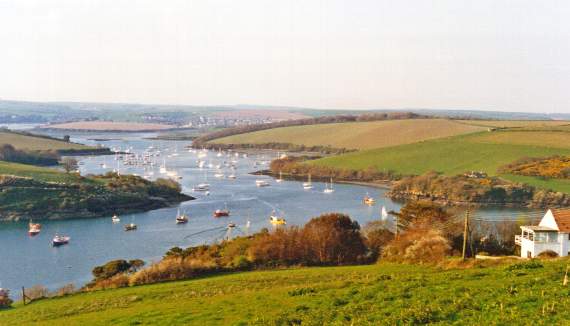
DEMANDS for the body responsible for the South Devon Area of Outstanding Natural Beauty to be more proactive in the planning process could come to a head at a meeting next Friday.
In September 2015, the National Trust published a report that found ’shortcomings’ in the way planning policy was being applied in AONBs, and this summer the trust’s Adam Royle gave a talk on the report in Kingsbridge.
The report and talk generated discussion around whether the AONB Partnership Committee and staff unit were doing enough to safeguard the area from excessive or inappropriate development, given AONBs are supposed to have the same level of protection as national parks.
Bob Harvey, a member of the partnership committee who represents amenity groups, has led the way in trying to pressure AONB staff and committee members to take a more active role in planning. At a meeting of the partnership committee taking place at 10am on Friday, December 2 at Follaton House, he will present his concerns and suggest that volunteers from amenity groups and town and parish councils could help in coming up with the AONB’s responses to planning applications.


Mr Harvey said: ’Ten years ago, it was easy: the AONB wasn’t under pressure from planning, there was plenty of money around, and it was able to run lots of projects for the public. Now, it’s the reverse: there are hellish planning pressures, but they still want to do all these projects like getting children to look in rockpools etc.
’I want them to get back to first principles. So what have they actually got to do? The answer is, protect the protected landscape, to the same level as national parks are protected.
’The AONB doesn’t comment enough, and doesn’t follow up enough. What we’re hoping to achieve is a stronger system for resisiting inappropriate development.
’The simple test should be, would it happen in a national park?’
In response, a spokesman for the AONB said the partnership regularly discusses planning and major developments, but this was just part ’of a much larger and wide ranging remit to conserve and enhance the natural beauty’ of the area.
They also noted the AONB was not a statutory consultee in planning applications affecting the area, planning authorities instead having to consult Natural England.
The AONB had ’an advisory role’, the spokesman continued, that seeks ’to ensure the conservation and enhancement of natural beauty is fully considered in all development proposals, that no harm comes to the defined special qualities of the AONB, and that where possible landscape management is fully integrated into development decisions’.
They added South Devon AONB communities need to be economically viable with adequate housing, amenities and facilities to meet local needs.
The spokesman said that given its limited resources and wide remit, the AONB has focused on contributing to planning policy and development plans, giving advice in response to requests from planning authorities, and offering training, tools, awareness raising and support. The AONB would comment on individual applications where they would have a significant impact on the AONB, or where they could establish an important precedent for further development.
The spokesman said the AONB was in the process of drawing up a detailed planning guidance document which ’once finalised, will address many of Bob Harvey’s concerns’.
They continued: ’The document gives detailed recommendations on 11 key types of development and as such will be of significant assistance to the four local authority planning teams, developers, applicants, parish councils and neighbourhood plan groups. It is intended that it will eventually be adopted as supplementary planning document which will raise its status and ensure that the advice within it is followed.
’Given the advanced stage of the planning guidance it is not deemed advantageous or appropriate to pursue the possibility of members of the public intervening in the process of drafting planning application responses, but as has always been the case we remain interested to hear all views on development proposals.’
Comments
This article has no comments yet. Be the first to leave a comment.