
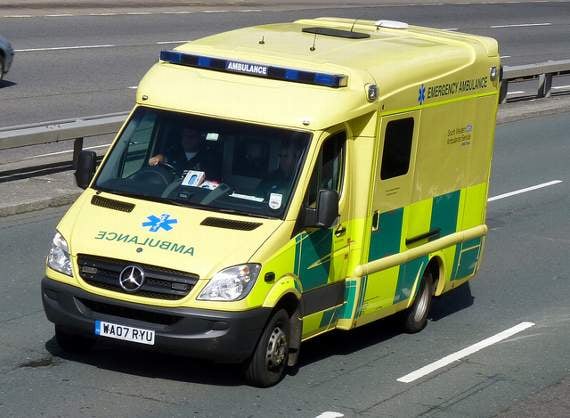
South Hams residents have said they are concerned about emergency response times after two incidents left victims waiting more than 45 minutes for an ambulance.
Over the course of a week, two incidents occurred in Salcombe where the response times were 45 minutes and an hour and a half.
This comes after figures released recently from NHS England showing the south west’s ambulance service is still failing to hit targets for reaching Category 1 – the most serious – and Category 2 patients within seven and 18 minutes respectively.
The south west paramedics are still taking an average of more than eight minutes to reach C1 patients.
.jpeg?width=209&height=140&crop=209:145,smart&quality=75)



A couple of weeks ago, a young boy tripped over his dog’s leash, smashing a glass and cutting his wrist badly.
Suzanne Spridgeon saw the holidaying family the following night.
“They had a long evening in A&E, but he was bandaged up and fine, said Suzanne. “Apparently, if the cut had been an inch longer, it would have been an air ambulance job, so he was quite lucky to have escaped a serious life-threatening injury.”
According to Suzanne, the
family waited 45 minutes for the ambulance before the father decided to take the child to Derriford Hospital himself.
Deb Ward, another witness when the boy was injured, described another incident that took place later that week, when a man at Salcombe Information Centre started to feel unwell, with numbness down the side of his face.
“We were advised to call an ambulance by our local GP, but waited over an hour and a half for it to arrive,” she said. “This is such a worry – what can we do as a community to get a reasonable ambulance response?”
A spokesperson for South Western Ambulance Service NHS Foundation Trust, said the incident with the young boy was classed as C3, while the man at the information centre was classed as a C4 patient, and said: “The SWASFT would like to apologise that we were unable to reach these patients more quickly. At the time of these calls there were several serious life-threatening, time-critical incidents in the area, including incidents where patients were unconscious and had stopped breathing.
“While we will always try to reach our patients in a timely manner, we must prioritise those with the greatest clinical need. Sometimes this means less poorly patients do not get the response we would wish.”
Medical executive director at SWASFT Dr Andy Smith said: “We’re reminding people to use the service wisely, and as high season approaches, we’re predicting a busy time ahead.
“Although we have more resources out, we only have a finite number of ambulances and highly trained paramedics available.
“We’d like to ask the public to stop and think, ‘is this an emergency?’ before dialling 999.”
According to the NHS website, the response time differs based on how serious the incident is. The new system for SWASFT, putting incidents into one four categories, C1 to C4, with C1 the most serious, has now been implemented.
A C1 response time is for time-critical, life-threatening illnesses or injuries, such as a cardiac arrest, a serious allergic reaction or a patient being unconscious or not breathing.
The target response time for this is seven minutes.
An ambulance arrives within 15 minutes in nine out of 10 of these cases. This also means that one out of 10 C1 patients are waiting more than 15 minutes.
C2 denotes emergencies such as a heart attack, stroke, epilepsy or other serious injuries, with a target of 18 minutes. Nine out of 10 respond in 40 minutes.
C3 are urgent, but not life-threatening injuries, with the national response time standing at 120 minutes, while the less urgent C4 response time is 180 minutes.
For more information on ambulance response times nationally and in the south west, visit england.nhs.uk.
Comments
This article has no comments yet. Be the first to leave a comment.