

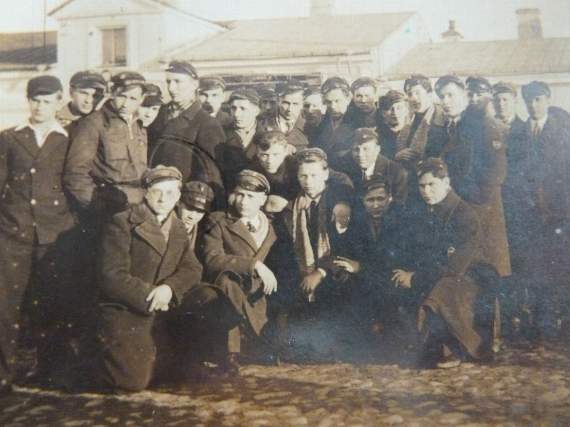
A LOCAL author from Malborough, Irena Clarke has written a book detailing her father’s harrowing experiences during the Second World War.
Waclaw Kossakowski was a Polish prisoner of war and was later involved in the campaign to liberate Italy.
Irena has written not only a military history book, but a story for everyone, about a young man whose only wish was to return home to his girlfriend and family.
Irena Clarke, née Kossakowski, who will be launching her book with a talk at the Royal British Legion Mill Club, explained: ‘For years my dad had nightmares and would wake up shouting in Polish. We knew something had happened, but knew nothing of his life during or after the war.’
After a while, Irena decided to keep a record every time her father mentioned something about the war. She later investigated his war records and travelled to Poland for research.
‘I’d try to get him to answer things and sometimes I’d ask him a direct question, but it took a very long time. All he’d ever say is he wanted to go home,’ Irena said.
Waclaw was studying maths at Warsaw University and due to being a Polish cadet, was imprisoned in the notorious Kozelsk prison and later sent to a labour camp in the Siberian Arctic Circle.
Waclaw was forced to dig runways in temperatures reaching as low as minus 50 degrees Celcius, while under constant threat from sadistic guards. He lived an indescribable living hell that Irena only found out about in snippets throughout his life.
He endured and witnessed atrocities which were to haunt him for the rest of his life, with many friends murdered or frozen to death in the unforgiving cruelty of Siberia.
‘They’d have to work 15 hours every day building the runways,’ Irena said.
‘He got frostbite and had to walk seven miles every day, living off fish soup. He didn’t have a change of clothes for two and a half years, there were no washing facilities and no medical aid,’ Irena explained.
‘Sometimes, the Russian soldiers would put their guns on the ground, stand back and shout at the prisoners “run.” But there was no where to run, they would either get eaten by wolves or freeze to death.
‘Even on Christmas day they had to work, no letters were sent or received and no mention of the war was made. They had no idea of what was going on in the outside world. To live like that for two years must have been so demoralising,’ Irena added.
Later fate intervened, and he was liberated and sent to the Middle East, where Waclaw was enlisted to fight for the Allies in the Italian campaign at Monte Cassino, Ancona and Bologna.
‘Suddenly his environment switched from temperatures of minus 40 to plus 40 degrees Celcius,’ Irena said.
Waclaw’s desire to return to his homeland never left him, but after the war, Poland was governed by the Soviet Union and it was impossible to return for fear of imprisonment or death.
Waclaw settled in England. He studied textiles at Nottingham University, met Irena’s mum and started a family.
He didn’t know if his mother and family had survived the war until 1959 when he received his first censored letter. He finally returned to see his family for the first time in 1966 and was sent to prison for a week.
It was only with the collapse of the Soviet Union in 1989 that the true story of what happened to the Poles during the war became apparent.
Waclaw died at the age of 94 in 2014 on the Isle of Wight. His ashes were sent to Poland for a soldier’s burial.
Irena paints a vivid picture of her father’s dramatic and poignant story. With an insight into a life that has been lost forever, Irena insists Waclaw’s story and the story of so many Poles should not be forgotten.
She settled in the South Hams, after falling in love with the coastline while her son was studying at Exeter University.
Irena is now travelling all over the world giving talks about A Homeland Denied, including a trip to Poland and a visit to Australia in the new year.
A Homeland Denied is published on Friday, November 11 by Whittles Publishing.
Irena will be giving a free talk at the Royal British Legion Mill Club on Western Backway, Fore Street, Kingsbridge on Friday, November 18 at 7.30pm.
Comments
This article has no comments yet. Be the first to leave a comment.