
Not long ago, I came across an article on the website of the Bumblebee Conservation Trust with the depressing title, “British Bumblebee Numbers Plummet in 2024”. Adverse weather in spring and early summer had played havoc with queens struggling to build nests, found colonies and feed themselves. The numbers of White-tailed and Red-tailed Bumblebees fell by 60 and 74% respectively. Although the counts for 2024 are the worst on record, I would advise anyone interested to read the whole article for a more nuanced discussion.
Yet again, it seems that we may have a guilty finger in the pie as our world heats up and our weather displays ever more capricious forms. Add in insecticides, habitat fragmentation and loss of wild flowers and we are back to the familiar litany of woe which is regularly and rightly aired in the media. You might almost be forgiven for thinking that all would be fine if humans behaved responsibly and that the bumbles would live happily ever after.
Nothing could be farther from the truth. The life of bumblebees is an unremitting battle to survive against a list of potential predators ranging from the usual suspects to some very specialised parasites indeed.
Let’s start with the more obvious threats. Any ground-nesting species can expect to attract the attention of a series of opportunistic omnivores and bumblebees are no exception – their fat larvae are a welcome source of protein for mice, foxes, badgers and hedgehogs, to name but a few.
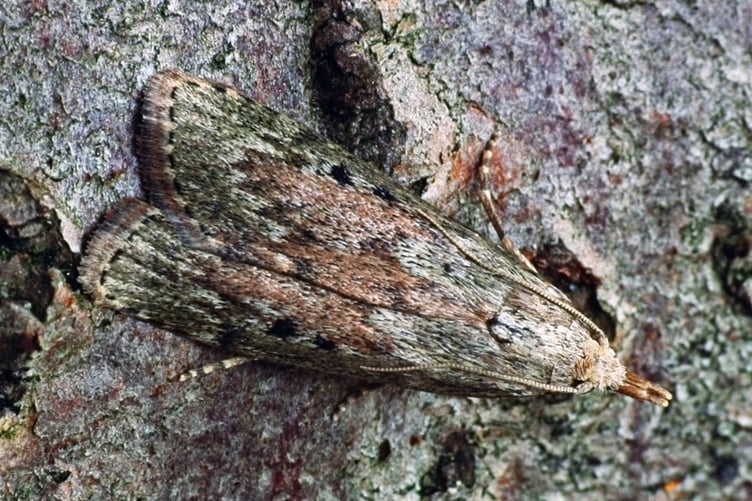
There is also a list of unwanted intruders which can cause all sorts of grief inside the nests. The actual structures in the nest can be affected by the Bee Moth (Aphomia sociella), whose caterpillars can quite happily munch through all the wax in the nest. The bee larvae can be attacked by the maggots of Brachicoma devia (a flesh fly), which have the uncanny knack of waiting till the bee grubs grow sufficiently to provide them with a good meal before attacking them. And let’s not forget mites and nematodes which can also cause havoc.
One extraordinary parasite is the Cuckoo Bee, a parasitic bumblebee of which there are six species in the UK. Cuckoo Bees don’t work at all – they lack the pollen basket on the hind leg which real bumblebees use to ship their pollen back to the nest. The females invade the nests of social bumblebees where they may kill the queen and let the original workers continue to work for them instead. They lay eggs in cells which the old queen had readied and their larvae consume the pollen store and/or the original bumblebee larva.
Flying back and forth can also mean dicing with death. Spiders are a constant nuisance. As temperatures rise, we may see Bee-eaters, ever partial to a fat bumblebee, becoming
established in the UK. Speaking of new species from the Continent, it probably won’t be long before the notorious Asian Hornet gains a foothold here. Strange but true, the bumblebees should be able to fight off these murderous newcomers. Research in Spain into interactions between the hornets and the Buff-tailed Bumblebee, one of our commoner species, revealed that when the hornets attacked the bees, the bees’ natural defence was to fall on the ground on their backs and stab upward with their stings. The hornets tended to give up when faced with this plucky defence.



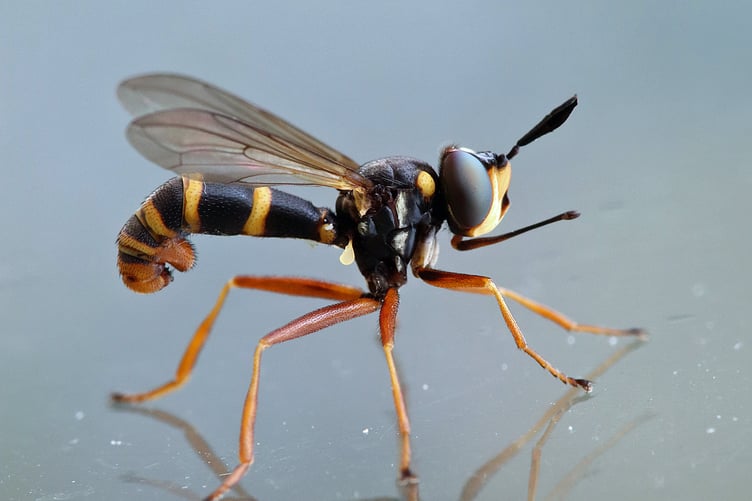
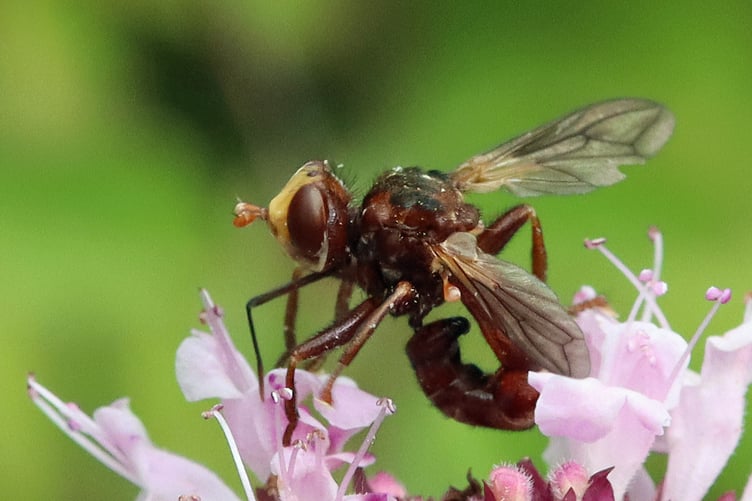
And the list goes on. Just when you think it couldn’t get worse, welcome to the world of Bee-grabbers. These are strange-looking flies of the family Conopidae which parasitise bumblebees. Some are black and yellow and oddly beautiful, some are a rather nondescript brown or grey. A number of species can be found here in the South Hams – I have seen them in Kingsbridge, Slapton and West Charleton.
Have a look at the photo of the Four-banded Bee-grabber accompanying the text. That large orange lump sticking out of the underside of its abdomen is called a theca and the fly uses it like an old-fashioned can-opener.
She leaps onto the back of a bumblebee, stationary or in flight, prises up the external plate on the bumble’s back with the theca and deposits an egg inside the bee’s body. The bumblebee then flies back to the colony where the fly larva will slowly develop and kill her but not before compelling the bee to dig herself in for the winter so the fly larva can spend the cold months safely underground protected by the dead bee’s body.
This article is not exhaustive but hopefully it gives you an idea of the trials and tribulations of bumblebee life. The bees have evolved to overcome all manner of predation and loss over the last 30 million years and they most certainly don’t need us adding to the list of
perils they face on a daily basis.
Comments
We've recently changed our login process. If you have an account for commenting, you will need to re-register on the login window.
This article has no comments yet. Be the first to leave a comment.