

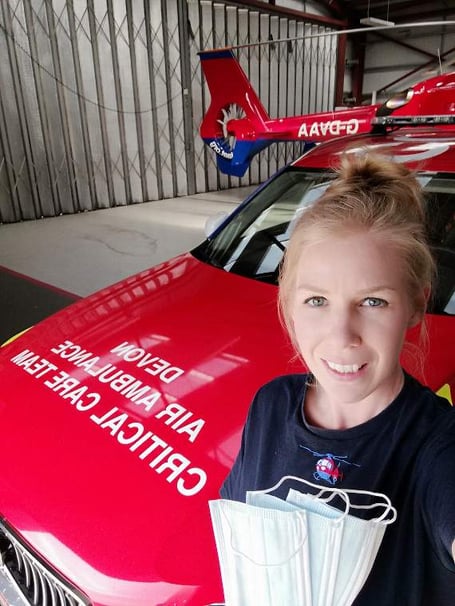
The Devon Air Ambulance Trust has been dealing with operational challenges head-on to find sustainable solutions to protect patients and staff during the coronavirus pandemic.
The trust’s EC135 helicopters have now been fitted with a prototype separation barrier which enables separation between the pilot, patient and clinical team.
The barrier, which has been designed by submarine engineers at Babcock Marine in Plymouth and the design team at Babcock Mission Critical Services Onshore in Gloucester, has been manufactured in Spain and approved through the EU and UK regulators in consultation with the aircraft manufacturers Airbus Helicopters UK.
To overcome the challenge of having an operational communications system which is compatible with FFP3 face-masks, has been overcome by working in partnership with Headset Services, who have developed a new throat microphone to improve aircrew communications.
.jpeg?width=209&height=140&crop=209:145,smart&quality=75)


These new mics fit around the neck of the crew and feed their voices directly into the aircraft comms system.
After a recent successful trial, the DAAT has placed an order for several sets of these new microphones.
The final operational challenge the DAAT has had to overcome is the aircrews personal protective equipment.
The use of full-face visors is an important part of PPE especially when certain medical procedures (where there is a higher risk of transmitting coronavirus by airborne particles) are carried out.
Until recently there was no approved mechanism to secure these visors to aviation helmets, however, the team at Babcock has also managed to design a new bracket, which will enable full-face visors to be attached to safety helmets.
Nigel Hare, the operation director of Devon Air Ambulance Trust, said: "Alongside these exciting developments our patient services team have been busy looking at ways we can protect and enhance our clinicians working environment (to safeguard them and our patients) and at what we can do to help the region-wide fight against coronavirus.
"There’s no doubt that global pressures on supply chains mean that we are spending more time sourcing PPE, but our focus is also on the day to day training that is required to help our teams carry out their work safely."
As well as overcoming design and technical challenges to keep the air ambulances operational the teams have been training in the effective use of level 2 PPE and level 3 PPE which they need to use when carrying out aerosol generation procedures, such as intubation and manual ventilation which place the crews at a higher risk of catching the virus through airborne transmission.
Nigel added: "We are extremely grateful to Luminous Show Tech and our colleagues at Wiltshire Air Ambulance and Kent, Surrey & Sussex Air Ambulance who have helped provide us with PPE."
“Although much of our work has been focussed on what we can do to protect our patients and staff in the pre-hospital setting, we are also helping to support the wider healthcare effort against coronavirus
"Once we saw the potential impact of the virus on our hospitals, we decided to release our doctors back to their host hospitals on the basis they would be able to treat many more patients there than they would in the pre-hospital environment.”
“We are proud to be supporting the South West Critical Care Network and five of our paramedics will be helping with the specialist transfer of patients between hospitals.
"That work is linked to the new Nightingale Hospital based in Exeter.
"Our highly experienced paramedics – who can provide a suite of enhanced skills – are currently in training alongside other critical care specialists as we help build our region-wide response and resilience to meet the coronavirus pandemic.”
Comments
This article has no comments yet. Be the first to leave a comment.