

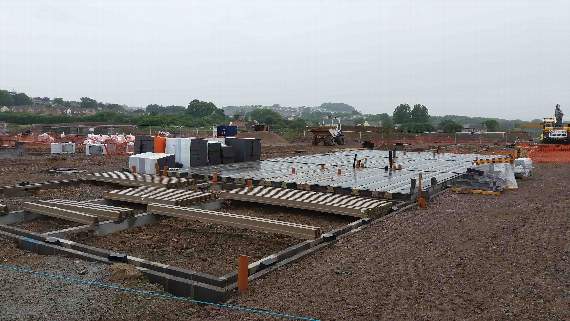
IT may need imagination to see it now, but a town the size of Ivybridge is about to rise out of the green fields where the South Hams meet Plymouth.
The foundations are being laid for the first of 5,500 homes in Sherford, the new town that will eventually house some 12,000 people.
The vast project, decades in the planning will take more decades to complete. When finished, the town and its associated 500-acre country park will occupy a huge swathe of land south of the A38 stretching almost to Brixton, with access from Deep Lane junction to the north, and Haye Road to the west.
The Haye Road entrance is almost complete, a sweeping stretch of brand new road running for several hundred yards alongside ’Quarry Wall’, the huge retaining bank built to screen the site’s best source of quality limestone from view. Past the wall, a wooden ’bat bridge’ comes into view, making a dramatic entrance to the town that will soon frame Sherford’s main street and its first homes.




At the moment, however, the vista is mainly of mud, although the Sherford Consortium of Bovis Homes, Linden Homes and Taylor Wimpey insists things are on track for the first residents to move in next spring.
Linden’s sales and marketing manager Brian Deacon said: ’We’re working on parts of the main street in this first phase, and construction of the primary school is about to start, which we’re committed to delivering by September 2017. Spring 2017 is our best guide for people moving in, we hope to have show homes ready right at the end of the year, followed quickly by houses for sale.
’Once we begin building, we’ll keep on delivering houses consistently for a good number of years.’
The three housebuilders will be offering a range of properties in the first instance, from two bedroom apartments to four bedroom family homes. But Mr Deacon said that prices would be decided ’nearer the launch’. He said: ’It’s difficult to be drawn on price when you’ve got such a unique offering. I don’t think any of the housebuilders are ready to quote prices, but we can say that there will be a broad range of homes, and a broad range of prices.’
Groundworkers have been on site for months under the direction of resident engineer Michael Stent. Long before house building can start, a huge amount of work must be undertaken in and under the ground. With neither big enough to take on the challenge individually, two of the South West’s largest groundworks companies, SHC and Champion joined together to create Groundfix, and won the contract for the preparatory work.
At one time, a worforce of 500 was on site, though now it is around 70. But this period before the house building proper starts is just a lull, according to Michael, before Sherford once more explodes into activity.
The engineer and his team have almost literally moved mountains, the complex business of extracting stone and stabilising the ground meaning entire hills have been levelled and rebuilt exactly as before, but using material from another part of the site. Strict rules dictate that nothing can be imported and exported from the land, except specialist grades of stone for road construction and drainage. But all the other stone used has been extracted from within the site.
Infrastructure is being put in on a grand scale, with entire roads ripped up, moved, closed and constructed. A vast drainage system designed to handle everything up to and including a one-in-a-thousand-year flooding event has been built, alongside a sewage station able to cope with the waste from thousands of houses, with six metre deep holding tanks the size of football pitches.
And yet, says Michael, the project is still to some extent at the mercy of the weather: using heavy machinery on wet earth runs the risk of ruining ground conditions for months to come.
But at the moment, the consortium’s outlook is sunny both on the progress being made, and the future benefits of Sherford to local communities. Linden Homes’ Brian Deacon again: ’The contribution it will make to the surrounding areas is positive, with the facilities available at Sherford open to people in surrounding communities as well.
’Local parish councils have been positive, and the improved road links, albeit they will take a while, will make it easier for local people to get about.
’I was pleased to visit one of the nearby primary schools which is doing some work on the project, and it was full to bursting. The delivery of eventually three primary schools is a good thing, and I’m pleased we made the commitment to open the first school early to help ease the pressure.’
Mr Deacon said some of the inspiration for Sherford had come from Poundbury, the controversial modern urban extension to Dorchester built in the 1990s. He continued: ’As someone who munches their cereal in the morning, I know that Dorset Cereals started in Poundbury. It’s a well known example, but what it means is that employment opportunities in Sherford will be real.
’Eventually there will be places to eat, places to buy groceries and clothing, and it’s important that we get those facilities early. Small businesses have been making enquiries and are keen to be involved, though of course the exact nature of the shops and busdinesses, and what goes in will to some extent be dictated by the community as it grows.’
While some who have been affected by traffic jams and disruption may question the wholly positive portrayal of the project, its vast scope and vision, and the huge sums of money involved, to some extent transcend ordinary concerns. For better or worse, Sherford is coming, and the nature of this corner of the South Hams will never be the same again.
Comments
This article has no comments yet. Be the first to leave a comment.