
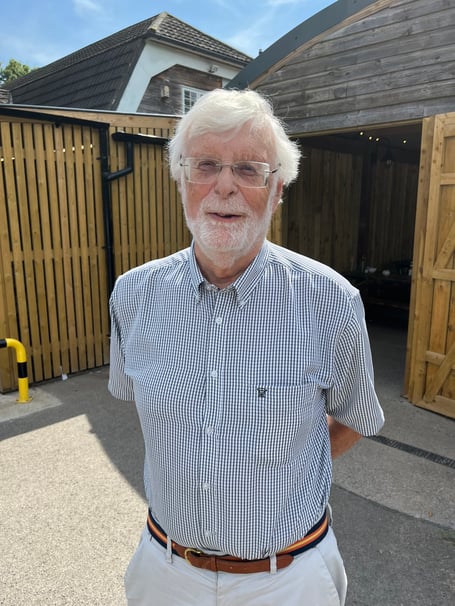
Residents of picturesque Yealmpton are not too happy about the change that’s coming around the corner when they become governed by the big city of Plymouth.
This distinctly rural village, which is seven miles from the urban centre, will have its bin collections, roads and social care services run by the city council from 2028, not South Hams District Council and Devon County Council like it does at present.
There is a fear that council tax will go up, parking will no longer be free, potholes will get bigger, and development will eat up the countryside.
No one really knows what the future will hold, but these real concerns are making the village of around 2,400 people, where businesses all work hard to look after each other, and a strong community spirit prevails, uneasy about local government reorganisation.
Central government has decided that the current system of local councils is far too complicated and is abolishing district and county councils in favour of larger unitary authorities responsible for all local services – that’s 11 councils going down to four.
In Devon that means an expanded Plymouth taking in 13 new parishes around its boundaries together with much larger Exeter and Torbay areas and a coast and countryside authority covering the rest of Devon.
Chair of Yealmpton Parish Council Keith Baldry said he didn’t know anyone who was in favour of the village coming under the governance of Plymouth City Council and survey results proved little appetite for it.
“People here don’t want to be part of Plymouth – that’s why they live here and the city council has no experience in how rural communities work,” he exclaimed.
“In a city bin lorries can collect rubbish door to door easily but in the South Hams you might have to drive three miles between dustbins and would need a very different refuse vehicle to get down the lanes and up the hills. Certainly electric vehicles cannot cope with that at the moment."
He said he was worried about Plymouth City Council’s level of debt, which is now around £700 million and the new parishes being burdened with that.

“It feels like a money grab as well as a land grab as there are more properties here in higher council tax bandings and this could raise a lot more income for the council.”
Devon County Council also has long-term debt, but it’s lower – £466 million according to the annual statement 2025/26 – and whilst residents of the South Hams will be helping to pay for this at the moment, the burden per head is less.
Clearly the Liberal Democrat run South Hams District Council can do no wrong in this community – residents seem very happy with the services it runs – and local councillors are familiar faces in the local shops.
Councillor numbers are set to reduce in the shake-up, meaning that ward councillors will have much bigger areas to cover and could become more distant.
Chair of Newton and Noss Parish Council next door, Peter Hinchliffe, said he felt that the rural voices could be drowned out.
“I think it will be difficult to get a rural view aired in Plymouth council meetings,” he said.
Resident Gareth Hammett talked about people being “anxious”. Whilst city council Labour leader Tudor Evans has promised that South Hams communities would keep their identity under the new council, Gareth said residents were worried they would not get the provision of services they were used to and potholes could get worse.
Fiona Logie of Yealmpton Stores said parking charges and rate increases had had an impact on Plymouth city centre and she would not want that to be replicated in her village.
“Here rates are reasonable and parking is free and as a small village we all feed off each other,” she said. “The sense of community here is massive. We run a general stores and there is an opticians, doctors’ surgery, two pubs, a post office, hairdressers, petrol station, dentists and several other shops. It’s nearly enough to supply the community with everything it wants. We want all this to continue.”
Nigel Taylor said he believed the biggest issue for the village where he had lived for 27 years was “increased urban sprawl” with the effects of Sherford – the new town on the edge of Plymouth – already having impacts on the countryside.
“You don’t have to walk very far into the surrounding countryside to see how Sherford is gradually encroaching on what is an area of outstanding natural beauty. It is rapidly being replaced by housing, and I think if we are not careful we are going to see it spreading between us all the way up to Ivybridge.
“We have some of the best countryside and beaches around us. I understand why people don’t really want it to change and want to protect what we have. We feel very lucky that we have a village community here.”
Rebecca Buller spoke of the contrast between urban and rural issues and the uniqueness of planning in small village communities, along with the importance of community centres, WIs and public toilets.
“We are concerned about the GPs continuing but in Plymouth the problems are different,” she said. “ I think we are more inward looking, it’s just a different way of life.”
She did say, however, that she believed mental health services were probably better in the city.
The local government shake-up is the first in 50 years, but the controversial carve-up of Devon announced last week has left Devon County Council considering a legal challenge against the government decision.
Rebecca Smith, Conservative MP for South West Devon, which includes Yealmpton, has also started a petition which has been signed by over 2,200 people.
She claims that the government has ignored concerns raised by residents, parish councils and community groups across South Hams and West Devon.
Critics say the government has also not abided by its own criteria by splitting current council boundaries and made the decision political by accepting Plymouth and Exeter’s suggestion rather than other options.
Leader of Plymouth City Council Tudor Evans tried to calm concerns this week by saying the council would be “a careful custodian” of the 13 parishes’ character and “their own strong sense of place”
“Their identity and their voice will matter in the new council and we will work with those communities not over them,” he said.
The council would ensure any transition was “ smooth, coordinated and focused on improving outcomes for our residents.”
Along with Yealmpton, the new “Greater Plymouth Council” will include Bickleigh, Shaugh Prior, Cornwood, Sparkwell, Harford, Ugborough, Ivybridge, Ermington, Brixton, Wembury, Newton and Noss and Holberton, bringing the council’s population area to 300,000.
Elections for the new council will take place in May 2027 with 68 seats up for grabs.
Comments
We've recently changed our login process. If you have an account for commenting, you will need to re-register on the login window.
This article has no comments yet. Be the first to leave a comment.