
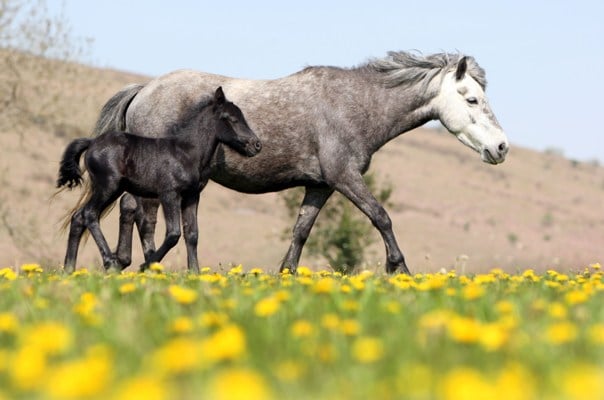
Dartmoor pony campaigners who feared the moorland grazing animal could be culled to reduce the population, have welcomed a ‘reprieve’.
It was feared the hill pony breed would face a severe cut in numbers and farmers and landowner would be forced to put down large numbers of the popular animal, which is beloved by visitors, under new reduced moorland stock quotas to support environmental management.
However, under an apparent reprieve, the Dartmoor Hill Pony Association (DHPA) has hailed a government pledge that moorland grazing numbers will not be cut, but warned the promise must now be written into grazing policy.
The DHPA (a charity protecting the breed) has welcomed a commitment from the environment secretary that there will be ‘no planned reduction’ in the number of Dartmoor ponies, and is now seeking reassurance that this will be reflected in policy and legislation as a matter of urgency.
Responding to a question in Parliament yesterday (Thursday, July 9) from Labour MP, Steve Race, the Environment Secretary Emma Reynolds said Dartmoor ponies are a ‘vital part of the landscape and history of Dartmoor, and that she wants to see pony numbers maintained and the condition of Dartmoor improved’.
The secretary of state also confirmed the government is working on solutions to support Dartmoor ponies and said promised to visit Dartmoor to see the ponies herself.
The DHPA welcomed the statement as an ‘important step forward’, but warned the commitment needs to be reflected in grazing agreements. The association says the ponies’ grazing habits are good for increasing and maintaining biodiversity on Dartmoor.
The charity it is calling on Natural England (which sets the stock numbers of all moorland grazing animals) and Defra (Department of the Environment, Farming and Rural Affairs) to implement the independent Fursdon Review on the future management of the moor which states: “Dartmoor’s pony population is genetically important and invaluable for conservation grazing. Ponies and cattle should not be linked for the calculation of agri-environment agreement stocking rates and Natural England should not take actions likely to result in a decline in pony numbers.”
The charity also says existing grazing agreements to be extended until the Dartmoor Land Use Management Group reports in 2027 and ensure future agreements do not lead to a decline in semi-wild Dartmoor Hill Pony numbers.
Charlotte Faulkner, chair of the DHPA, said: “This is a very welcome statement from the secretary of state. Dartmoor’s semi-wild Hill Ponies are native, iconic and vital to the future of the moor.

.jpeg?width=209&height=140&crop=209:145,smart&quality=75)

“The commitment that there will be no planned reduction in Dartmoor pony numbers is exactly the reassurance people have been looking for.
“The next step is to turn that promise into policy. That means implementing recommendation 27 of the Fursdon Review, so ponies and cattle are not linked together in stocking-rate calculations and no action is taken that leads to a decline in pony numbers.”
Charlotte added: “Dartmoor does not need fewer ponies. It needs a grazing policy that keeps the endangered and genetically rare ponies where they belong on the moor.
”This makes it even more important that future stocking agreements do no force commoners to cull the semi-wild pony herds.”
Comments
We've recently changed our login process. If you have an account for commenting, you will need to re-register on the login window.
This article has no comments yet. Be the first to leave a comment.