
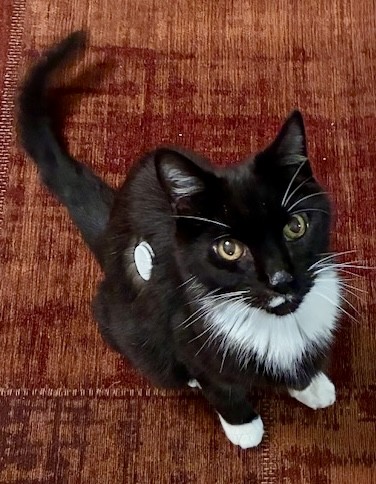
Clyde is a beautiful black and white cat who has always enjoyed his food. However, last summer, his appetite was getting even more voracious than usual. Despite this, when he came in for his annual check-up at South Moor Vets, we found that he had lost 20% of his body weight and was looking rather thin. We took some blood and urine samples and diagnosed that Clyde was diabetic.

In the past, the only treatment available for diabetic cats was an injection of insulin twice a day, along with a special diet. This treatment is usually effective, and most cats will lead a long and happy life; however, a newer treatment was recently licensed for cats. It uses a tasty oral liquid instead of injections and typically requires fewer vet check-ups - most of the time, a better combination! Clyde started taking the liquid on his food whilst his owners checked his urine in his litter tray to make sure he was well.
Over the following six months, Clyde’s appetite became more normal, his energy levels improved, and he gained a little weight. However, just after Christmas, he suddenly became very poorly. Over 90% of cats do really well with the liquid medication, but in Clyde’s case, he developed ‘diabetic ketoacidosis’. This is where the body switches to alternative energy sources as it is unable to use the sugar in the bloodstream, acids then build up, and it can be rapidly life-threatening.
Clyde was hospitalised for 3 days at our Dartington practice, where he was looked after day and night by the nurses and vets. He was given a mixture of medications, fluid and insulin drips to bring his body back into balance and get him eating again. Once stable, he started on insulin injections, which his owners gave at home twice a day.
Different cats need different insulin doses. To determine the correct dose, we used a combination of clinical signs such as appetite, drinking, weight and demeanour along with measurement of blood sugars. Rather than having samples taken all day, Clyde was fitted with a human ‘FreeStyle Libre’ glucose sensor. This device monitors his sugar levels continuously for up to two weeks and reports them via bluetooth to an app on his owner’s phone. The data uploads to the cloud so that we can log in and view his sugar levels from the practice (or anywhere in the world!) and make decisions about his treatment. Clyde is continuing to be a fantastic patient and doesn’t appear to notice the small white disc of the FreeStyle Libre on his side.
Clyde has been gaining weight and feeling well as he settles into his new routine. We are continuing to adjust his insulin and food requirements as he gets back to his normal self. Clyde’s case shows how a combination of well-established medicine, new technology and good old-fashioned TLC can really lead to great outcomes for our animal patients.
Comments
This article has no comments yet. Be the first to leave a comment.